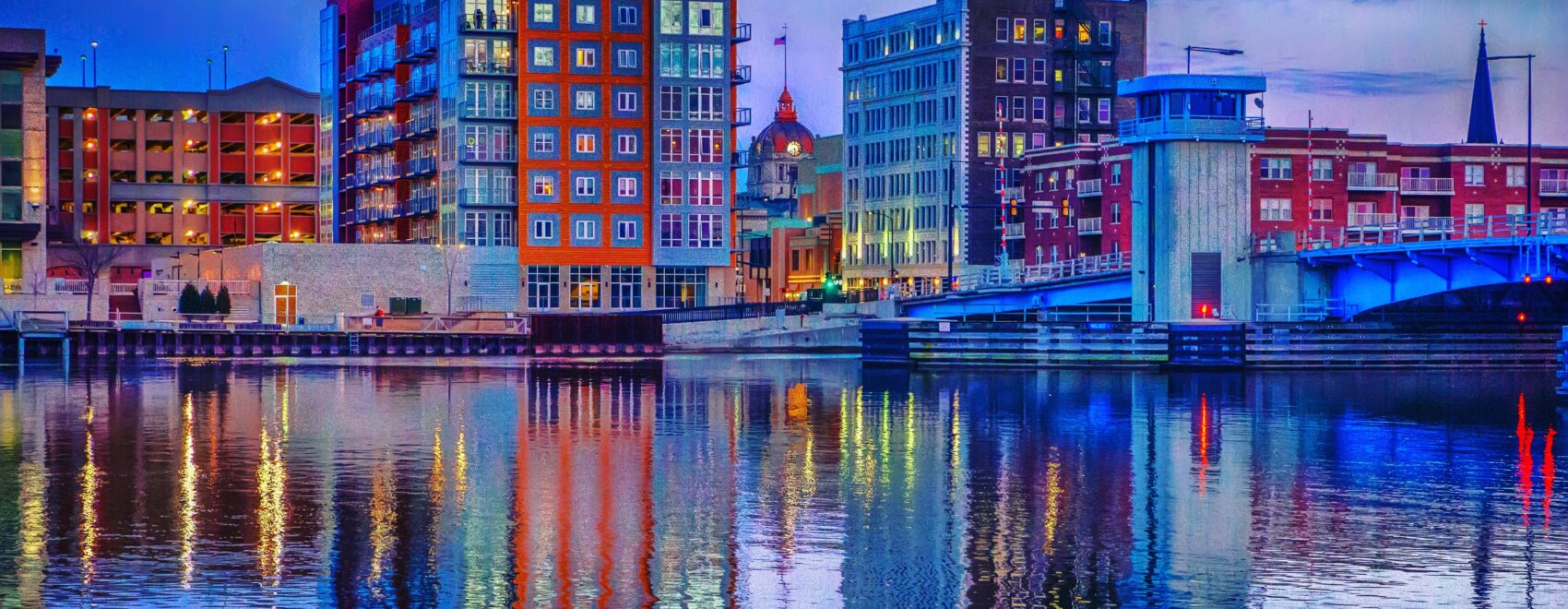
Why Downtown Development Actually Works: The Green Bay Model
Here’s something I learned over 16 years as mayor: downtown revitalization isn’t magic, and it isn’t accidental. It’s a deliberate strategy that starts with one simple question: what does your downtown actually need to become a place where people want to live, work, and gather?
For most of the 1990s and early 2000s, Green Bay’s downtown had an answer to that question, and it wasn’t pretty. Bars literally had their backs to the Fox River. Parking lots dominated the landscape. Historic buildings like the Hotel Northland sat half-empty as low-income housing instead of the destination landmark it could be. The riverfront itself was contaminated—decades of industrial discharge had left it off-limits for real connection. People didn’t turn toward the river; they turned away from it.
That’s the “before.” And I want to be clear: that “before” was what Green Bay accepted as normal.
The Catalyst: One $14 Million Bet
In 2003, when I took office, my team and I sat down with urban planners, architects, and the community and asked: what’s the single investment that would change how people see this city?
The answer was the CityDeck—a $14 million public boardwalk built between 2009 and 2012 along a quarter-mile stretch of the Fox River. And here’s the critical part: we didn’t wait for private developers to ask for it. We built it first. Public investment. Municipal risk.
The CityDeck isn’t flashy. It’s a wooden boardwalk with terraced levels, gathering spaces, docks, and direct access to the river. It’s got fishing piers, transient dock space for boats, and it functions as a flood barrier. The design is elegant but simple: we wanted people to physically turn toward the river instead of away from it.
That $14 million public investment became the catalyst for $250 million in private development. That’s not coincidence. It’s how market dynamics actually work: when you signal to developers, business owners, and residents that city leadership is serious about quality of life, capital follows.
The Cascade: Projects Building on Projects
Here’s what happened next. When developers and business owners saw the CityDeck working—saw people actually gathering at the river, saw the aesthetic transformation—they started asking: what else is possible downtown?
CityDeck Landing came in 2013—76 units of the first downtown residential apartments in over 20 years. Not subsidized housing. Market-rate apartments with river views. Young professionals started choosing to live downtown. That matters.
The Hotel Northland restoration started in 2008 and opened in early 2019. This took 11 years. Eleven years of conversations, structural engineering, financing arrangements, and patience. The project cost $50 million. It became a 160-room Marriott Autograph Collection property with ballrooms, upscale restaurants, and a presence that says to visitors: Green Bay is a destination. That landmark went from a symbol of decline to a symbol of confidence.
The Railyard Innovation District transformed 22 acres of historic warehouse space. This was the location where someone had pitched us a big box Walmart. We said no. Not because we’re anti-retail—we’re not. But because one-dimensional development serves a community for about 15 years, and then it’s obsolete. Mixed-use serves it for generations.
Instead, we worked with developers to create co-working space, historic office rehabilitation, townhomes, and hundreds of units of housing in buildings that had been sitting empty for decades. Today, the Railyard is one of the most active parts of the city. Titletown Brewery operates in the Larsen Cannery building—a 1917 historic structure repurposed into the Cannery Public Market and hospitality space. The Fort at the Railyard brought 233 units of mixed-income housing.
Metreau Apartments. Whitney School converted to lofts. The Farmers Market on Broadway—now Wisconsin’s largest farmers market with 120+ vendors. Bay Beach got a $100-foot Ferris wheel, the Big Wheel, with 20 wheelchair-accessible gondolas. These aren’t separate projects; they’re a system.
The Math: What Wasn’t There, What Exists Because of Leadership
Let me give you the side-by-side that matters.
What Wasn’t There (Pre-2003):
- Activated waterfront (bars turned their backs)
- Downtown residential options
- Historic landmark hotels functioning as destinations
- Mixed-use vibrancy
- Reason for people to walk along the river
What Exists Because of Deliberate Civic Strategy:
- 2.5-acre CityDeck boardwalk with year-round programming
- 160-room Marriott Autograph Collection Hotel Northland
- 76-unit CityDeck Landing (first downtown apartments in 20+ years)
- 22-acre Railyard Innovation District with 233+ housing units
- Cannery Public Market (1917 historic repurposed)
- Metreau Apartments, Whitney School Lofts
- 40+ miles of connected trails
- Farmers Market on Broadway (Wisconsin’s largest)
- Bay Beach expansion with iconic attractions
The Financial Reality:
- $14 million public investment (CityDeck) sparked $250 million in private development
- Property values grew to $6 billion in assessed value
- Tax base grew by $30 million in new taxable capacity
- Moody’s maintained Aa3 credit rating—one of Wisconsin’s strongest
That’s not luck. That’s strategy.
The Strategic Decisions That Mattered
I want to extract something here that other communities can actually use. Because this model is replicable, and I think there are lessons that matter.
1. Anchor project first, private follows.
The CityDeck was a public bet. We didn’t wait for a developer to come to us with a vision. We invested in quality of life, and private capital responded. That’s the order.
2. Quality of life attracts talent; talent attracts employers.
This was explicit in our strategy. Young professionals leave cities that look like they’ve given up. They stay in cities that are making visible investments in livability. When we saw young people choosing downtown Green Bay over Milwaukee, that signaled everything working. Employers follow that talent.
3. Historic preservation is an economic tool, not sentimentality.
Tax credits, federal financing mechanisms, and the craftsmanship of old buildings—these aren’t sentimental. They’re economic. The Hotel Northland, the Railyard, the Cannery—these projects became viable because we understood how to leverage historic preservation as a financing strategy.
4. Say no strategically.
When Walmart came to us wanting a big box store on prime downtown real estate, the city said no. Not because Walmart is evil. But because one-use development closes off future options. We encouraged mixed-use development instead. That decision—to reject short-term revenue for long-term vibrancy—paid off in ways we’re still seeing.
5. Streamline permitting.
Nothing kills development faster than bureaucratic gridlock. We cut our building permit timeline from 8 weeks to 4 weeks. Simple processes, clear expectations, responsive city staff. Developers want to work in cities that don’t make them jump through endless hoops.
6. Public investment first.
This is non-negotiable. CityDeck. River cleanup. Trail systems. These aren’t things private developers build. They’re things cities build, and they’re what make everything else possible.
7. Mixed-use beats single-use every time.
A downtown of nothing but office parks dies at 5 p.m. A downtown of nothing but retail dies when the economy shifts. Mixed-use—residential, retail, office, hospitality, recreation—creates 24-hour vitality and builds resilience against economic shifts.
8. Waterfront access matters.
This seems obvious, but it’s not. Turning people toward water instead of away from it changes how a community sees itself. CityDeck did that. Now people gather at the river. That’s worth $250 million in private investment.
9. Patient capital.
The Hotel Northland took 11 years. We didn’t pressure developers into bad deals. We created conditions where the right deal could happen, and we waited for it. That patience paid off in a project that works.
The Green Bay Model in Plain Language
Here’s what I tell other cities that ask me about this: downtown revitalization works when you do these things in this order.
First, you diagnose what quality of life actually requires in your community. Not what consultants think it needs. What people say they want.
Second, you make public investments that signal: we’re serious about this. CityDeck wasn’t a small gesture. It was substantial public capital deployed to transform the waterfront.
Third, you clear obstacles—zoning, permitting, financing mechanisms. Make it easier, not harder, to build downtown.
Fourth, you diversify. Residential and retail and office and hospitality. Not one thing.
Fifth, you say no to things that close off options. Walmart could have occupied that land for 20 years. Mixed-use development created something that serves the community for generations.
Sixth, you measure results not in ribbon cuttings but in people. Are young professionals choosing to live downtown? Are visitors coming? Are local businesses investing? Are property values appreciating? These are the metrics that matter.
Why This Matters Now
I’m not the mayor anymore. Someone else has the job. But the model I’m describing—it’s not about me. It’s about a replicable strategy for communities that have written off downtown as lost.
Downtown isn’t lost if you’re willing to invest in it strategically. Not haphazardly. Not with one big project and hope. But with a coherent vision: activate the waterfront, attract talent, create mixed-use vitality, say no to things that foreclose options, and measure by results.
Green Bay’s downtown in 2019 looked nothing like Green Bay’s downtown in 2003. That didn’t happen by accident. It happened because leadership—elected officials, business leaders, neighborhood advocates—decided that downtown mattered and that quality of life was the economic development strategy. Everything else followed from that.
Listen to Lean Local Sundays at 7 a.m. on 97.9 FM—where I continue the conversation about what builds thriving communities.