There is a corner in the heart of downtown Green Bay that I have been thinking about for a long time.
Most people know it as the old Boston Store building. For a while it became Baylake City Center. More recently it was converted into housing and rebranded as City Center Lofts. This week, it was listed for sale.
I want to tell you why that matters, and why I think this moment is worth a real public conversation.
We had a plan.
Back in 2014, Green Bay did something I was genuinely proud of. Through a process called the AuthentiCity Plan, residents, business owners, civic leaders, and city officials came together and agreed on a shared vision for downtown. It was not a quick process and it was not a small group. People showed up. They talked. They disagreed on some things and agreed on others. And when it was over, there was consensus around a clear direction.
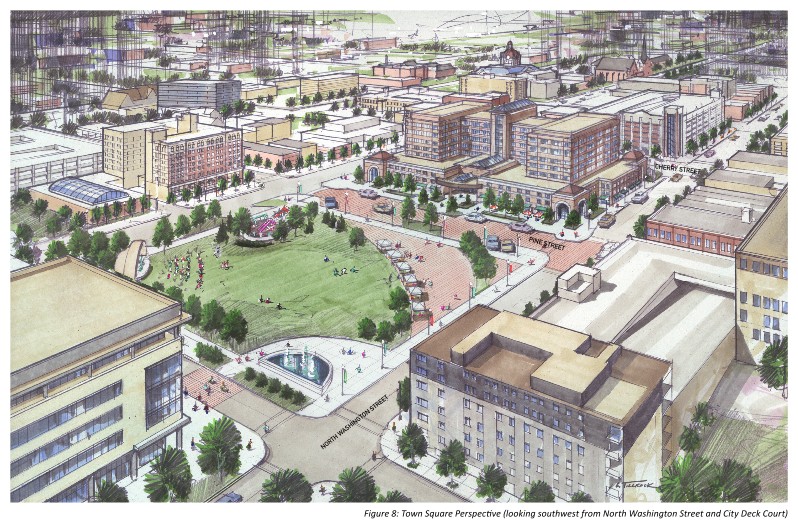
If you have never seen the drawings, here is what that plan actually showed. A full city-block public square between Washington and Adams, framed by Schreiber Foods, Hotel Northland, the Children’s Museum, and a new mixed-use building. The idea was simple: a central green space surrounded by activity on all four sides, used for concerts, markets, and everyday gathering – a true town square, not just an empty lot.
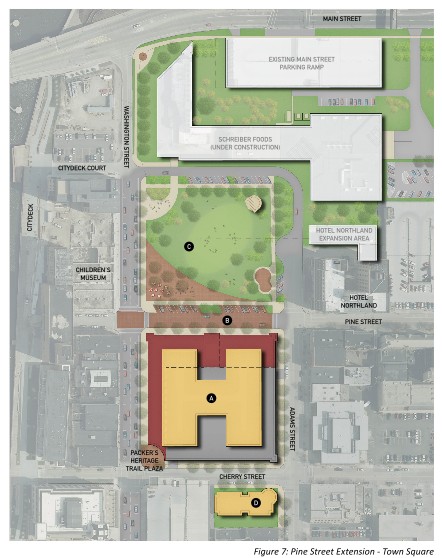
One of the central pieces of that vision was this corner.
The plan called for removing the old Boston Store building and creating a downtown public square – a genuine gathering space, right in the middle of downtown. A place people would actually come to. A front door for the city.
Downtown Green Bay Inc. supported it. The Green Bay Planning Commission approved it. The City Council approved it. Business leaders across sectors backed it. And I signed it as mayor.
I want to be clear about something: it was not my plan. It was Green Bay’s plan. I just signed it.
Then things changed.
After I left office, a different direction was taken. The building was converted into affordable housing by Gateway Collective, a nonprofit affiliated with St. John’s Ministries. I want to say this carefully, because I mean it: housing is a genuine need in Green Bay, and I have deep respect for the people working to address it. I spent years at New Community Shelter. I understand what housing instability does to people and families.
But the question was never whether housing matters. The question was whether this was the right project for this location. And at the time, I was not alone in raising that concern. City Council President Brian Johnson publicly said the project “just isn’t a product that fits the future vision” for downtown. The Green Bay Redevelopment Authority expressed reservations as well.
I raised my concerns through proper channels – Downtown Green Bay Inc., the Planning Commission, the mayor’s office. I was told nothing could be done.
Now the building is for sale.
The residential portion of the property is listed at $17 million. The commercial ground floor is listed separately at $1.55 million. I am not here to pass judgment on those numbers or on the people who made decisions along the way. What I will say is this: when a building of that scale comes back to market, it creates an opening. And openings do not stay open forever.
The question is not who to blame for what happened. The question is what Green Bay does now.
The vision is still valid.
Cities our size have invested in downtown public spaces and watched economic energy grow around them. It is a proven model. People gather where there is something to gather around, and businesses follow people. Downtown Green Bay has real momentum right now – along the river, near Lambeau, in pockets all over the city. This corner deserves that same energy and that same ambition.
Maybe the answer today looks exactly like the 2014 plan. Maybe it looks different – a mixed-use project that incorporates civic space, or something new that reflects how the city has grown over the last decade. I do not claim to have the final answer.
What I do believe is that the community should be part of deciding. You weighed in once, back in 2014. That instinct was right then. It is right now.
If you want to go deeper, you can read the original 2014 plan recommendations for this square, including diagrams and renderings, here:
Download the AuthentiCity Town Square plan excerpt.
This is where you come in.
I am asking a simple question, and I want to hear real answers from real Green Bay people.
What do you want that corner to look like?
Not in a general, theoretical way. Specifically. If you drive past it, walk past it, own a business nearby, or just care about what downtown Green Bay looks like for the next 20 years – I want to hear from you.
Use the form below to share your thoughts. A few questions, two minutes of your time. I will read every response, and I will keep this conversation going on Lean Local.
Green Bay solved hard problems before when people showed up and pulled in the same direction. This is one of those moments. The building is for sale. The corner is open. What we do next is up to us.
About the Author:
Jim Schmitt served as Mayor of Green Bay from 2003 to 2019. He is the host of Lean Local on Civic Media, a weekly conversation about Green Bay’s future. Share your thoughts at greenbayway.com.