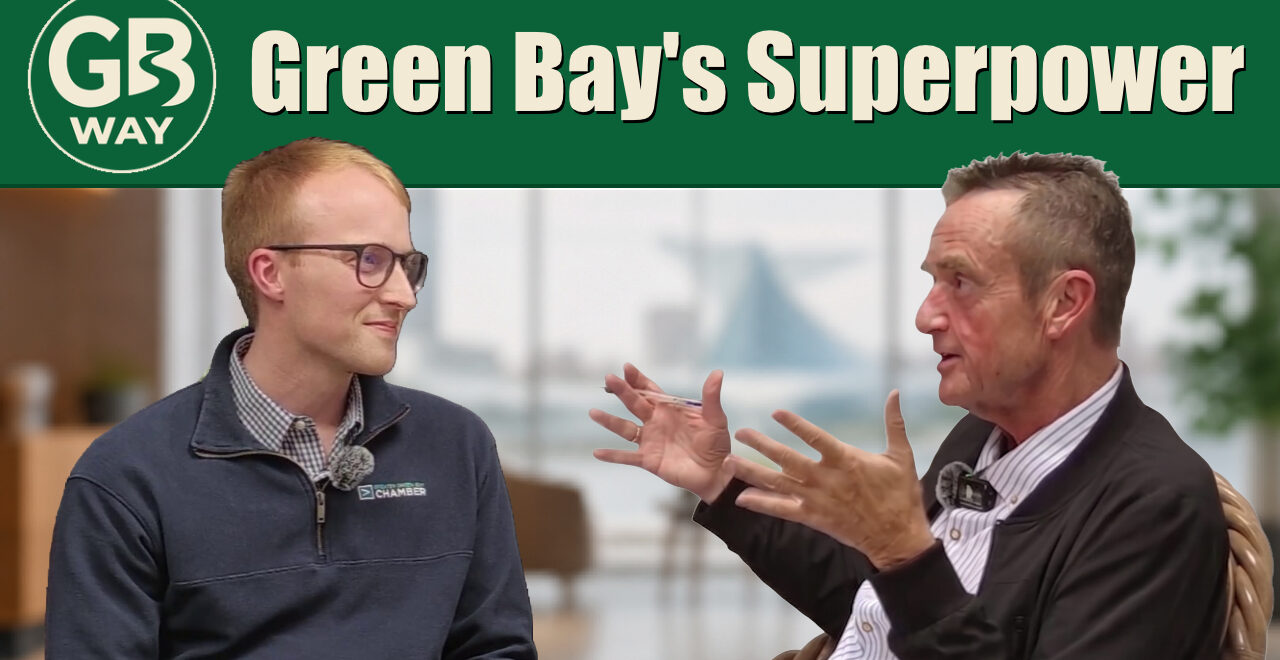
Jim Schmitt sits down with Shane Kanneberg from the Greater Green Bay Chamber for a Green Bay Way conversation about what it really takes to build a business in Greater Green Bay. The episode starts with a simple idea: when a local entrepreneur wins attention or recognition, that success rarely happens in isolation. Behind the founder is a larger ecosystem of people, spaces, relationships, and practical support.
Shane brings two useful perspectives to that conversation. Through the Chamber, he works directly with entrepreneurs and startups. In his own life, he is also connected to the day-to-day reality of building and operating a business through Vine & Virtue Farm, which describes itself as a family farm just west of Green Bay. That combination gives the conversation a grounded feel. This is not only a discussion about programs and buzzwords. It is about what founders actually need when they are trying to get from an idea to a durable business.
A Startup Ecosystem Is More Than One Founder
One of the strongest through-lines in the episode is that entrepreneurship is not a solo sport. Jim and Shane talk about the visible entrepreneur, but they keep returning to the network around that person: mentors, peers, lenders, customers, educators, chamber partners, and community members willing to make an introduction or share what they have learned.
That matters because early-stage founders usually face several problems at once. They need relationships with other entrepreneurs. They need access to capital. They need practical knowledge about the next decision in front of them. They may need affordable space, help understanding regulations, or a place where other people understand the pressure of starting something new.
The Green Bay startup ecosystem, as Shane describes it, is strongest when those pieces are connected. A founder with an idea does not only need encouragement. They need a path into the right room, the right resource, and the right conversation.
The Startup Hub, the Urban Hub, and the Value of Place
A large part of the episode focuses on the Startup Hub and the Urban Hub. The Greater Green Bay Chamber describes the Startup Hub as a community where entrepreneurs at every stage can meet, create, and collaborate. In the conversation, Shane explains how spaces like this can give entrepreneurs more than a desk or office. They create proximity to people who are wrestling with similar problems.
That proximity matters. Jim points back to the value of an incubator environment, especially for founders who may not be able to afford every piece of infrastructure on their own. A shared space can reduce friction. It can also create the kind of daily overlap where founders compare notes, trade warnings, and see that other people are pushing through the same hard stages.
The Urban Hub adds another layer to that conversation. Rather than treating entrepreneurship support as one building or one program, the episode frames the work as an ecosystem that should reach different parts of the community and different kinds of entrepreneurs. Events, coworking, incubator support, and resource navigation all become part of the same larger goal: helping more local businesses get started and stay here.
Capital Matters, But It Is Not the Whole Answer
Jim and Shane also spend time on capital, because money is often the first thing people name when they talk about startups. Shane does not dismiss that. Access to capital is real, and undercapitalization can damage a business before it has a chance to stabilize.
But the episode is careful not to reduce entrepreneurship to funding alone. Money without preparation can disappear quickly. A founder also needs to understand the market, the cost structure, the customer, the regulatory environment, and the day-to-day discipline of running the business. That is why the conversation keeps circling back to education, peer support, and research.
The practical takeaway is that capital works best when it is paired with judgment. The question is not only, “Can this founder get money?” It is also, “Does this founder have the relationships, information, and support needed to use that money well?”
Collaboration Is Green Bay’s Superpower
The clearest moment in the episode comes when Shane names collaboration as one of Green Bay’s biggest strengths. He talks about how willing people are to share knowledge, tell their stories, and help each other out. That shows up inside the Startup Hub, but also across the broader Greater Green Bay area.
That kind of culture is hard to buy. Cities can build offices, launch programs, and create funding tools, but trust and willingness to help have to be practiced over time. Shane describes hearing from someone outside the area who was struck by how well Green Bay works together. For Jim and Shane, that is not a small compliment. It is a competitive advantage.
The Green Bay Way theme fits naturally here. The episode is not saying entrepreneurship is easy in Green Bay. It is saying the community has a habit of showing up for people who are trying to build something. That habit can make the difference between an isolated founder and a founder with a real shot.
Keeping Entrepreneurial Talent in Greater Green Bay
Another important section of the conversation looks at talent. Jim asks whether Green Bay loses entrepreneurial talent to larger cities, and Shane connects the answer to opportunity. If young people and early-stage founders can see strong local examples, access local resources, and find a path to build here, the region has a better chance of keeping that energy.
That is partly a storytelling challenge. The community needs to share local success stories so students, young professionals, and future founders can see entrepreneurship as something that happens here, not only somewhere else. It is also an ecosystem challenge. If a founder has to leave the region to find support, capital, or a peer network, Green Bay loses more than one business idea. It loses momentum.
Founder Resilience and the Entrepreneurial Mindset
Near the end of the episode, Jim and Shane talk about restaurants, small businesses, risk, and founder resilience. Those examples broaden the conversation beyond high-growth startups. Entrepreneurship is not limited to one type of company. It includes people opening restaurants, building farms, testing services, launching products, or applying an entrepreneurial mindset inside an existing organization.
That distinction is useful. A strong startup ecosystem should support high-potential companies, but it should also respect the broader entrepreneurial spirit that keeps a local economy adaptive. Some founders need incubator space. Some need a mentor. Some need help understanding financing. Some need a community that does not treat failure as the end of the story.
Why This Conversation Matters
This Green Bay Way episode is ultimately about the infrastructure behind local ambition. The most visible part of entrepreneurship is the business name, the storefront, the product, or the founder on stage. The less visible part is the network that helps someone keep going when the first version of the plan meets reality.
Shane’s message is that Greater Green Bay already has important pieces of that network, and that collaboration may be the community’s strongest asset. The opportunity now is to keep strengthening those connections, keep telling local success stories, and make it easier for the next founder to find the right door.