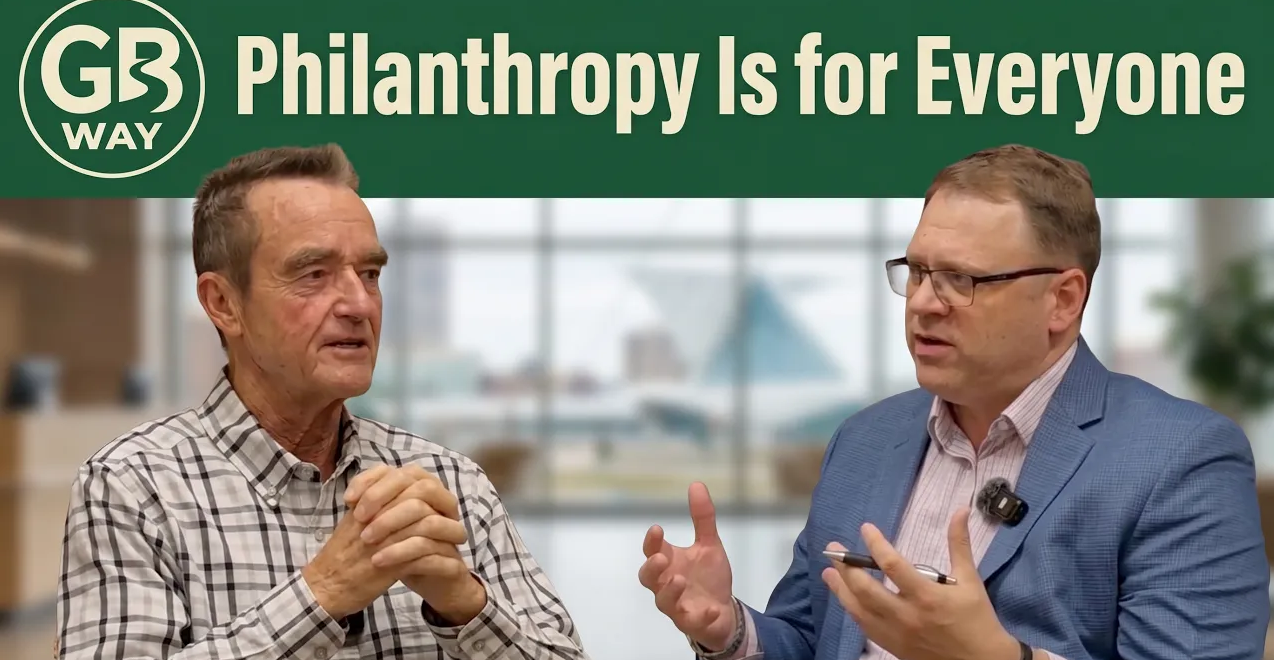
When most people hear “Greater Green Bay Community Foundation,” they picture a room full of wealthy donors writing big checks. Dennis Buehler, the Foundation’s President and CEO, wants to change that perception – and after spending an hour with him on the Green Bay Way, so do I.
The truth is, the Community Foundation is one of the most underutilized tools in this city. And that’s not Dennis’s fault. It’s ours for not paying closer attention.
It’s Not Just for the Wealthy
The Foundation isn’t a club for high net worth individuals. It’s more like a town square – a place where anyone who wants to do something good for this community can come in, sit down, and figure out how to make that happen.
Whether you’re a retiree looking for your next chapter, a young family that just wants to get involved, or a business owner thinking about your legacy – the Foundation has tools to connect you with the causes you care about. Financial giving is one path. Volunteering is another. So is simply showing up and understanding the need.
Dennis put it simply: philanthropy means to love one another. It’s not about the size of your checkbook.
The Needs Nobody Sees
One of the most important things Dennis said was about hidden need. Green Bay is a generous community – but that generosity can create a blind spot.
We see homelessness on the street. We don’t always see the domestic violence happening behind closed doors. We understand there’s a drug problem, but we underestimate how deep it runs. I said the same thing when I was in office – I didn’t think heroin was as big a problem as it was until we started peeling the onion back. It was.
The Foundation’s job is to surface those hidden needs, connect them to resources, and make sure the people who want to help can actually find where the help is needed.
The One-Time Money Problem
Here’s something that doesn’t get talked about enough: the danger of windfalls.
A big grant comes in. A bequest lands. ARPA dollars flow through. Everyone celebrates. Programs get launched. Then the money runs out – and the gap left behind is sometimes worse than if nothing had started at all.
Dennis called this the ARPA cliff. Nonprofits built programs on federal relief dollars that were never going to last. Now philanthropy is being asked to fill holes it didn’t create. The lesson isn’t to avoid big investments. It’s to plan for what happens after them.
When Government Needs a Partner
Most people don’t know this: the state of Wisconsin placed $35 million in trust with the Greater Green Bay Community Foundation, along with the Fox Valley and Oshkosh foundations, to protect and maintain the Fox Lock system on the waterway between Green Bay and Lake Winnebago.
That’s not a donation. That’s a government choosing a community foundation as the most trustworthy steward of public dollars for a long-term public asset. That says something about what this institution actually is.
What Green Bay Needs to Do
Dennis wasn’t interested in pointing fingers at government or criticizing nonprofits. That’s not how he operates. But he was direct about one thing: the nonprofits in this community are under enormous pressure, working with limited resources, serving real people with real needs – and they deserve more respect and more support than they typically get.
No single entity – not the city, not the county, not the federal government, not the Foundation itself – can solve these problems alone. The answer is always a coalition. Always a combination of public dollars, private philanthropy, business investment, and individual action.
That’s the Green Bay Way.
Dennis Buehler is President and CEO of the Greater Green Bay Community Foundation. This conversation originally aired on the Green Bay Way podcast. To learn more about the Foundation or get involved, visit ggbcf.org.
Watch on YouTube or subscribe to the Green Bay Way wherever you listen to podcasts.